Ultimate IR Nerve Block & Neurolysis Reference
Purpose: This excel is a tool for individuals performing nerve blocks and neurolytic procedures. It standardizes clinical indications, anatomy and technique, CPT coding logic, coverage risk, and documentation language to support defensible decision-making, accurate billing, and consistent procedural notes in real-world IR practice.
Date Created: December 2025
Authors: Jackie Brenner, Jaclyn Lundberg
How to use this excel:
This excel is a practical reference for individuals who perform nerve blocks and neurolytic procedures.
It is designed to help you do three things reliably:
1. Decide whether a block is reasonable for a given patient
2. Document it clearly and defensibly
3. Code it in a way that minimizes audit and denial risk
How the Excel Is Organized
Each block appears across multiple sheets. You are meant to move between them depending on what question you’re answering.
Recommended Way to Use It:
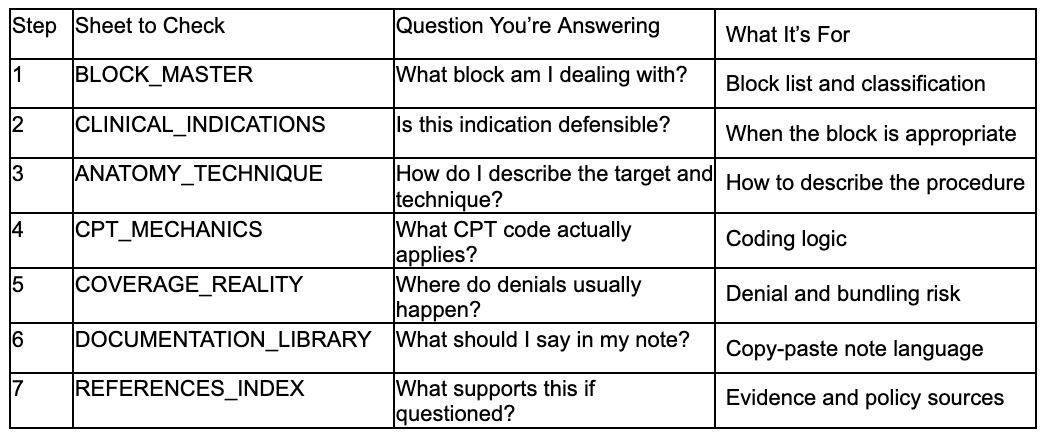
Sheet-by-Sheet:
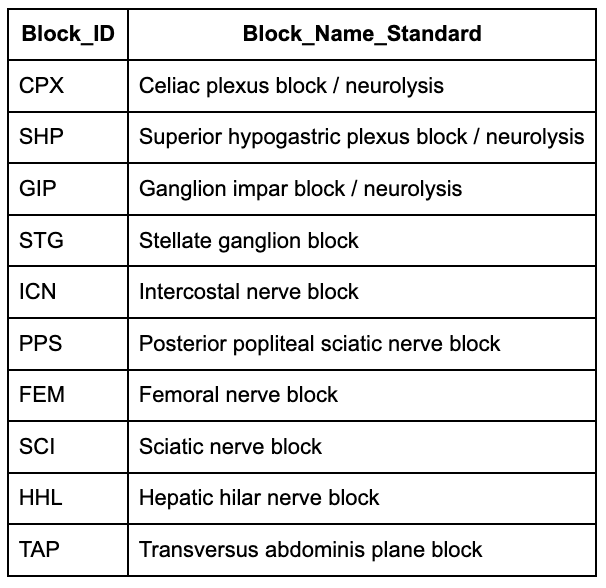
BLOCK_MASTER
This is the index
It tells you:
• What the block is called
• Whether it's central vs peripheral
• The anatomic region
• The block family (plexus, ganglion, peripheral nerve, fascial plane)
Use this to orient yourself
CLINICAL INDICATIONS
This sheet answers: "When does this block make sense?"
Each row is one indication, with:
• Clinical context (cancer, trauma, peri-procedural, chronic pain)
• Strength of support (high, moderate, low)
• Policy sensitivity (low vs high risk)
This is where you quickly see which uses are routine and which are likely to be questioned.
ANATOMY_TECHNIQUE
This sheet answers: "How do I describe what I actually did?"
It gives you:
• Plain-English target descriptions
• Billing-safe language
• Whether laterality is required
• Typical imaging guidance
Use this when dictating so your note clearly matches what the CPT code expects
CPT_MECHANICS
This is the coding logic sheet.
It explains:
• The correct CPT code (s)
• When add-on or continuous codes apply
• Block vs neurolysis distinctions
• When unlisted codes are appropriate
• Whether imaging guidance is included or separate
If there is any uncertainty about coding, this sheet is meant for that
COVERAGE_REALITY
This sheet answers: "What usually gets denied, and why?"
It summarizes:
• Coverage strength by indication
• Common denial reasons
• Bundling risk (low, moderate, high)
• The most defensible ("green zone") scenarios
This reflects real payer behavior, not theoretical coverage.
DOCUMENTATION_LIBRARY
This is the copy-paste sheet.
It contains:
• Indication language • Imaging language
• Target confirmation language • Block vs neurolysis intent statements
• Unbundling or postoperative language when needed
Use this to standardize notes and avoid vague wording that triggers audits.
REFERENCES_INDEX
This is the source list.
All citations, guidelines, CPT Assistant references, CMS/NCCI documents, and payer policies live here.